
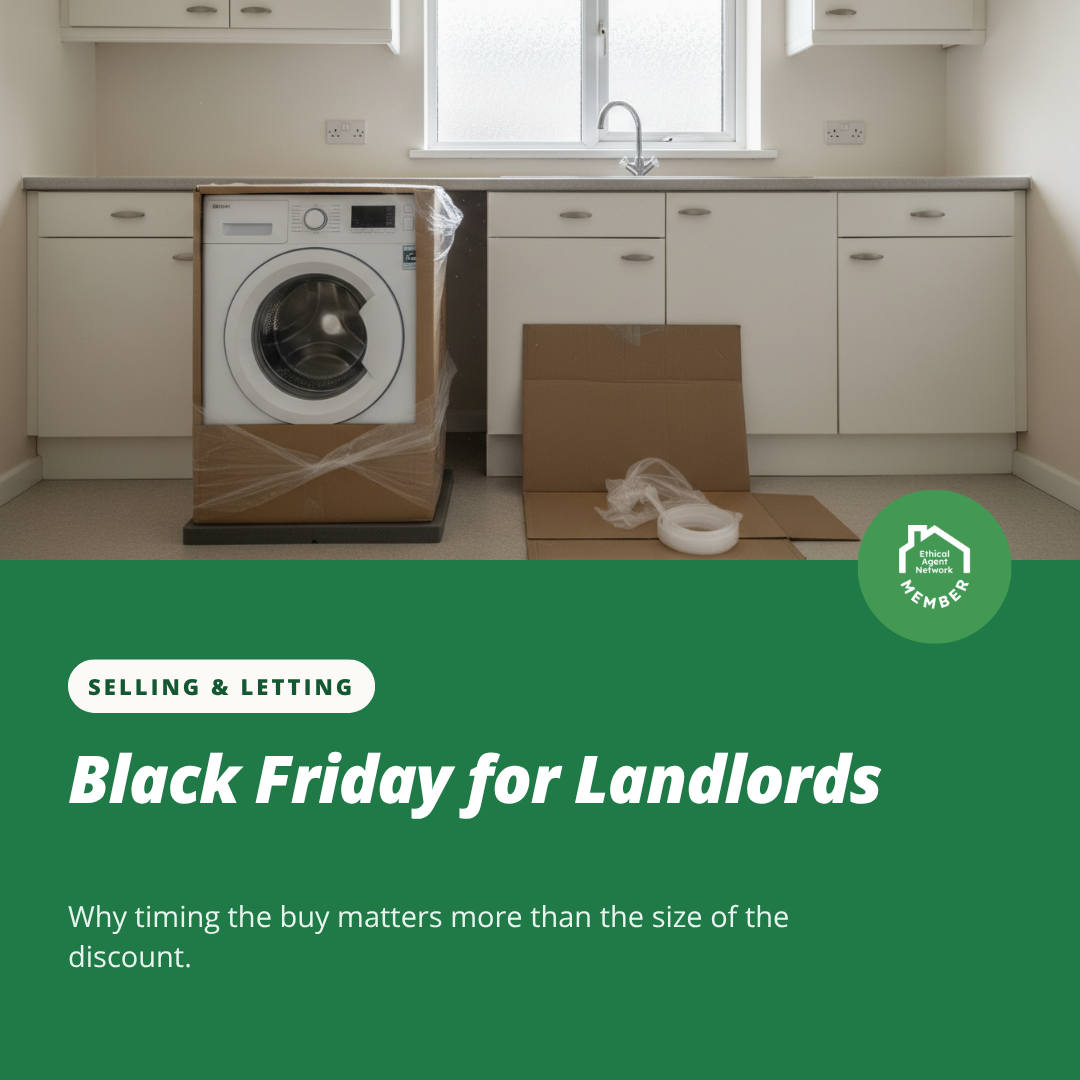
For once, the last week of November is genuinely useful to a landlord. Appliances, tools and safety kit all get cheaper at the exact point in the year when you can still fit them before winter properly bites.
The trick is knowing which discounts are real value in a rental, and which are a saving you pay for twice.
What is genuinely worth buying in the sales?
Things that fail, things that get stolen from the budget, and things that stop a call-out.
- White goods, if yours are limping. A fridge freezer or washing machine that is already noisy will not survive another tenancy, and replacing it on your terms is far cheaper than replacing it on a Sunday.
- Smoke and carbon monoxide alarms. These are a legal requirement in rented homes and they have an expiry date printed on them that most people never look at. Buy spares.
- A decent set of draught proofing, brush strips and letterbox brushes. Cheap, quick, and they reduce both bills and complaints.
- Thermostatic radiator valves and a programmable thermostat, if the property still has neither. They cut the arguments as much as the cost.
- Basic tools and consumables you always end up buying at full price mid-job. Filters, seals, spare keys, bulbs.
What is a false economy in a rental?
Anything chosen on price that will be used five times harder than it would in your own home.
A cheap oven in an owner occupied house gets careful treatment for fifteen years. The same oven in a busy let gets used by people who did not choose it and will not repair it, and it will be back on your maintenance list within two. Buy the model that is easy to service and has parts available, not the one with the biggest percentage off.
Be particularly wary of very cheap flooring and very cheap paint. Both look like a saving and both get replaced at the next change of tenant.
What about furniture, if you let furnished?
Buy it, but check the label before you check the price.
Upholstered furniture you supply in a letting has to comply with the Furniture and Furnishings (Fire) (Safety) Regulations. Worth knowing that the rules changed recently. The 2025 amendment came into force on 30 October 2025 and removed the display label, the swing tag that used to hang off new furniture in a showroom. The permanent label attached to the item now carries the compliance information on its own.
So do not reject a bargain because there is no swing tag, and do not assume a secondhand marketplace find is compliant just because it looks new. Check the permanent label and keep the receipt.
Is it worth buying energy efficiency measures now?
Yes, and increasingly it is not optional.
Insulation, draught proofing and better heating controls all reduce the running cost for the tenant, which reduces the complaints, the condensation and the void periods. They also move you in the direction the energy efficiency rules are travelling for rented homes over the coming years.
Doing that work in a planned way, at a discount, in a property you can access is considerably cheaper than doing it in a hurry against a deadline.
When is the best time to actually fit it?
Between tenancies if you can, and in daylight either way.
A void week is the cheapest week you will ever have for works. Nobody is inconvenienced, access is not an issue, and a job that would take two visits around a tenant’s shifts takes one. If you have a property changing hands this winter, get the list of jobs done in that gap rather than promising to come back.
If the property is occupied, be realistic about December. Contractors are stretched, parts take longer to arrive, and the fortnight around Christmas is close to dead. Buying in the sales and fitting in January is a perfectly good plan, as long as it is a plan and not a drift.
Anything that adds a maintenance obligation for a benefit the tenant did not ask for.
Smart doorbells, complicated heating apps, hot tubs and elaborate garden structures all sound like they add value. In a rental they mostly add things that can break, accounts that need transferring, and arguments about who is responsible. Ask whether it will still be working, and still be yours to fix, in three years.
How should you plan the spend?
Walk the property first, then shop. Not the other way round.
Almost every wasted purchase in this list comes from buying because something was cheap rather than because something was needed. Take fifteen minutes per property, write down what is genuinely near the end of its life, and buy against that list. Then keep the receipts and the manuals somewhere you will find them.
Frequently asked questions
Can I claim these purchases against tax?
Repairs and replacing like for like are generally treated differently from improvements, and the treatment depends on your circumstances. Keep every receipt and take advice from an accountant rather than guessing, because the distinction matters more than most landlords expect.
Do I have to tell the tenant before replacing an appliance?
You need their agreement to access the property and you should give proper notice, so tell them regardless. In practice, most tenants are delighted, and a replacement arranged around their week is far easier than one imposed on it.
Is secondhand furniture allowed in a rental?
Yes, provided it complies with the fire safety regulations. The permanent label is what evidences that. If an item has no permanent label and you cannot establish its compliance, do not put it in a let.
If you know a landlord about to spend money this week, please share this with them first.
About the Ethical Agent Network
We are proud members of the Ethical Agent Network (EAN), a national group of independent agents who have been independently assessed against strict standards of honesty, service and community care. It is not something you can pay to join. It has to be earned. When you see the EAN logo, you are looking at an agent who has been checked and trusted to do right by you. If you would like to know more about the Ethical Agent Network, please get in touch or visit www.ethicalagentnetwork.co.uk.
Sources: The Furniture and Furnishings (Fire) (Safety) Regulations 1988; The Furniture and Furnishings (Fire) (Safety) (Amendment) Regulations 2025 (SI 2025/531), in force 30 October 2025, legislation.gov.uk. Checked and verified in force 9 September 2026.
