


 With headlines proclaiming Britons were likely to pay 80% more for household energy costs this autumn, the Government has taken swift action with its proposed energy plan, the Energy Price Guarantee.
We’ve summarized here some key highlights of the plan, as well as actions homeowners and renters can take to control their costs.
What’s covered by the Energy Price Guarantee? And what’s not?
The bill announced by Prime Minister Liz Truss is intended to cap and control the rate of increase, in the face of shortages and supply risks related to the war in Ukraine and the global energy supply chain. The proposed plan addresses the rates that energy providers can charge but does not cap the cost of utility bills per se. As summarized by the BBC and other news sources:
• A typical household’s energy bill will rise to £2,500 a year from 1 October (from £1,971) vs a previously projected £3,549 a year
• The “energy price guarantee” will last for two years to lessen that cost
• The government mandated rate is fixed, but homeowner and renter bills will continue to be based on actual usage – there is no ‘cap’ on total billable amounts
• The plan applies to all households in England, Scotland and Wales, with a comparable plan being developed for Northern Ireland
• Proposed one-off £400 fuel bill discount payments for households will go ahead in addition to the ongoing reduced rates
• The rates apply to most energy sources for heating and electricity, including heating oil
• There is no application process and individuals do not need to contact their energy providers
• The government plans to offset energy providers’ costs
 What are the rules for renters?
• The Energy Price Guarantee is applied per unit of gas or electricity used for any household with a domestic electricity connection
• The cap will be applied if your landlord has a domestic electricity contract with a licensed electricity supplier
• Your landlord may be reselling the electricity to you based on your usage, in which case:
• They must comply with the maximum resale price rules – no profiteering on price
• The maximum resale price for electricity is currently set at the same price as the price paid to acquire it
Your landlord may charge an ‘all inclusive’ rent, where a fixed cost for energy usage is included in your rental charges, in which case:
• They are encouraged to come to an agreement with tenants on the Energy Price Guarantee in line with the arrangement in their tenancy agreements
• The landlord’s fixed charge may already provide tenants with similar protection from the impact of energy price increases
• The intent is for a plan to ensure landlord compliance and recourse for renters
How does the price cap work?
In all cases, the Energy Price Guarantee will replace the existing energy cap, which sets the highest amount suppliers are allowed to charge per energy unit. These energy units are displayed as kilowatt hours (kWh) on utility bills.
The estimated ‘typical’ household bill of £2,500 a year assumes 12,000 kWh of gas used per year, and 2,900 kWh of electricity per year. Note that there really is no ‘typical’ user or rate of use. The actual bill will reflect size of home, number of energy users in the property, rates of use and so on. Big energy users can expect to pay more than £2,500, and people who use less energy will pay less.
Consult the www.gov.uk link below for sample energy costs based on property size/usage
How Can Homeowners and Renters “Go Green” and Keep Their Costs Low?
Even with the rate caps, the cost of energy is going up. Homeowners and renters alike can take simple actions to reduce energy usage and further control their energy costs. Here are a few suggestions:
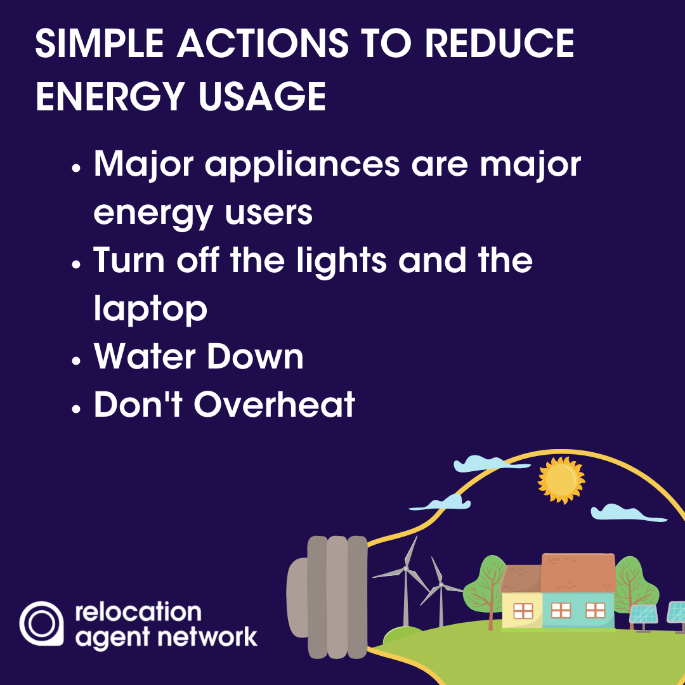
Major appliances are major energy users
Use an extra spin cycle in the washer…it reduces drying time. Consider line drying whenever possible
Wash in cold water and save the high energy cost of heating water
Don’t overpack the fridge – blocked air circulation makes the appliance less efficient
Turn off the lights and the laptop
Lights out is simple enough, but also unplug laptops, TVs, chargers
Your favorite gadget is using energy whenever it’s plugged in
Water Down
Maybe not fewer showers but definitely consider shorter ones
One dishwasher cycle is more eco-efficient than multiple sinkfulls of handwashed pots and pans
Don’t Overheat
Keep your winter thermostat at 22 and get cozy blankets
Program your smart thermostat to turn down the heat when you’re not home.
 For more information:
https://www.bbc.com/news/business-58090533
https://www.gov.uk/government/publications/energy-bills-support/energy-bills-support-factsheet-8-september-2022
Richard James has been hand-selected by Relocation Agent Network to be East Northants Local Expert when it comes to buying, selling, and renting.
Contact us today at 01933 224400 to find out more.
Relocation Agent Network and Dwellworks. All information deemed reliable but not guaranteed.